NMN vs Nicotinamide Riboside for Dogs: Which NAD+ Booster is Best?
As our canine companions age, we naturally seek ways to support their health and vitality. Nicotinamide mononucleotide (NMN) and nicotinamide riboside (NR) are two prominent NAD+ precursors gaining attention for their potential to promote healthy aging and overall well-being in dogs. But with both showing promise, which is the better choice for your furry friend? This article will delve into the science behind NMN vs nicotinamide riboside for dogs, exploring their mechanisms, benefits, and considerations to help you make an informed decision.
Understanding NAD+ and Its Importance for Dogs
Nicotinamide adenine dinucleotide (NAD+) is a crucial coenzyme found in every cell of a dog's body. It plays a vital role in numerous biological processes, including cellular energy production, DNA repair, and gene expression. Think of NAD+ as the fuel that keeps your dog's cellular machinery running smoothly. As dogs age, their NAD+ levels naturally decline, which can contribute to age-related decline and increased susceptibility to health issues. Reduced NAD+ levels are associated with decreased cellular energy, impaired metabolism, and reduced ability to repair cellular damage.
Supplementing with NAD+ precursors like NMN and NR aims to boost NAD+ levels, potentially counteracting the effects of aging and promoting overall health. By increasing NAD+ levels, these supplements may help support healthy aging, increase cellular energy, and support overall vitality in dogs. Learn more about NAD+ and its importance.
NMN vs Nicotinamide Riboside: How They Work
Both NMN and NR are precursors to NAD+, meaning they are converted into NAD+ within the body. However, they differ slightly in their molecular structure and the pathways they take to become NAD+.
- Nicotinamide Mononucleotide (NMN): NMN is a nucleotide derived from ribose and nicotinamide. Once ingested, NMN is converted into NAD+ through a two-step process involving the enzyme nicotinamide mononucleotide adenylyltransferase (NMNAT). Research suggests that NMN can be directly absorbed into cells, where it is then converted to NAD+.
- Nicotinamide Riboside (NR): NR is a form of vitamin B3. It requires an additional step compared to NMN to be converted into NAD+. NR is first converted to NMN by the enzyme nicotinamide riboside kinase (NRK) and then converted to NAD+ by NMNAT.
The key difference lies in the initial step. NR requires NRK to convert to NMN, while NMN can potentially be directly utilized. The efficiency of these conversion pathways can vary depending on factors such as age, tissue type, and individual differences.
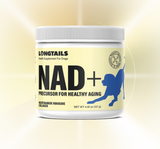
LongTails' NAD+ Precursor supplement supports cellular health and vitality.
Potential Benefits of NMN and NR for Dogs
While research on NMN and NR in dogs is still emerging, early studies and extrapolation from human and rodent studies suggest several potential benefits:
- Supports Healthy Aging: By boosting NAD+ levels, NMN and NR may help counteract age-related decline and promote healthy aging in dogs. This includes supporting cognitive function, mobility, and overall vitality.
- Promotes Increased Energy Levels: NAD+ is essential for cellular energy production. Supplementing with NMN or NR may help increase energy levels and combat fatigue in older or less active dogs.
- Supports Healthy Metabolism: NAD+ plays a role in metabolic processes, including glucose metabolism and fat oxidation. NMN and NR may help support a healthy metabolism and weight management in dogs.
- Supports Cardiovascular Health: Some research suggests that NAD+ may support cardiovascular health by promoting healthy blood flow and vascular function.
- Supports DNA Repair: NAD+ is involved in DNA repair mechanisms. By boosting NAD+ levels, NMN and NR may help support DNA repair and protect against cellular damage.
Considerations When Choosing Between NMN and NR
Choosing between NMN and NR for your dog can be challenging, as research is ongoing. Here are some factors to consider:
- Bioavailability: Bioavailability refers to the extent to which a substance is absorbed and utilized by the body. Some studies suggest that NMN may have better bioavailability than NR, meaning it may be more readily absorbed and converted to NAD+. However, more research is needed to confirm this in dogs.
- Research: While both NMN and NR have shown promise, there is currently more research available on NR, particularly in human studies. However, NMN research is rapidly growing.
- Cost: NMN is generally more expensive than NR. This is a factor to consider if you are on a budget.
- Individual Needs: The best choice for your dog may depend on their individual needs and health status. Consult with your veterinarian to determine which NAD+ precursor is most appropriate for your furry friend.
Ultimately, both NMN and NR hold promise as NAD+ boosters for dogs. More research is needed to fully understand their effects and determine the optimal dosage and form for canine use. Consulting with your veterinarian is crucial to determine the best approach for supporting your dog's health and well-being.
References
[1] Yoshino, M., Yoshino, J., Kayser, B. D., Patti, G. J., Franczyk, M. P., Mills, K. F., ... & Imai, S. I. (2018). Nicotinamide mononucleotide increases muscle insulin sensitivity in prediabetic women. Science, 341(6141), 1243-1246.
[2] Conze, D., Brenner, C., & Kruger, C. L. (2019). Safety and metabolism of long-term administration of NIAGEN (nicotinamide riboside chloride) in a randomized, placebo-controlled clinical trial. Scientific Reports, 9(1), 20571.
[3] Elhassan, Y. S., Kluckova, K., Fletcher, R. S., Schmidt, M. S., Garten, A., Doig, C. L., ... & Lavery, G. G. (2019). Nicotinamide riboside augments the aged human skeletal muscle NAD+ metabolome and enhances insulin sensitivity. Cell Metabolism, 30(4), 679-688.